Monday, April 30, 2012

Literacy: writing the end of a story

 We read the beginning of the story Mystery at Musket Bay, and we thought about what might happen next.  The crew of the Saucy Sally have received a mysterious message in a bottle, from someone shipwrecked on Dead Man's Island.  We began our work by drawing a map of Dead Man's Island.  My map is shown above.  Yours might be different, according to your imagination.

Next we planned what was going to happen in our continued stories.  The first thing to plan is the ending.  Have the ending in your mind before you start to write.  Also plan any problems your characters will have to solve before they reach the ending.  My planning notes are shown on the board above.  I made up two characters, one good and one bad.

At home please spend half an hour working on your story.  If you do not manage to finish the story in that time, do not worry.  Here are some points to remember:
  • Write in sentences with full stops.  Read your work aloud to hear where the full stops go.
  • Plan ahead.  Do not make it up as you go along.
  • Use speech only once or twice.  Most of the story should NOT be speech.
  • Make the ending worthwhile.  It could be a surprise, or a happy ending, or something that the reader has guessed might happen because of clues you have written.
Enjoy writing your story.

Maths: standard written multiplication

Yesterday we used the grid method of multiplying.  We could see where each number came from.  The grid method is shown on the left side of the board above.  On the right side, the same multiplication has been done using a standard written method.  I have used a colour code to help show that the numbers on the right are the same ones that appear on the left.
560 on the right comes from 80 x 7
63 comes from 9 x 7


Here are two more examples.  Next to the numbers you can see explanations of where they came from.  The last step is to add the two numbers to get the final answer, which is shown in green.

Sunday, April 29, 2012

Topic: choosing the right fabric

We visited the BBC Education website and chose clothing for different seasons.  In the winter we need to wear wool, polyester and nylon.  Wool is a good insulator and keeps us warm.  Polyester and nylon are warm, waterproof in the rain, and easy to wash.  In summer we need to stay cool.  Cotton and linen allow the air to circulate, so our skin can breathe and stay fresh. 

Maths: grid multiplication

We practised grid multiplication today.  We learned it in the first term and we called it partitioning.  We know how to split a 2-digit number into tens and units, multiply them separately, and then add the answers.  This is the same thing written in a different way.  We became so confident that we extended our work and multiplied 3-digit numbers too.

At home please do sheet 40 which has 2-digit numbers.  It is easier than today's classwork.  Enjoy doing your homework.

Literacy: Katy's Dog comprehension

 We looked very carefully at our answers to the comprehension questions about Katy's Dog.  Questions 5 and 6 were quite hard because we had to read carefully and think.  When Katy called Dylan after she had returned from the park, he did not bark an answer to her and he did not come to her.  That tells us that he would usually have done both those things, or the writer would not have bothered to tell us that he did not do them.  Katy's father said that Dylan was bright (clever) and would find his way home, which Dylan did.

Getting full marks for question 7 was not easy.  Dylan was battered because he had fought with two other dogs (that's the easy mark) but he was muddy because he had been out all night.  If we read carefully, we see that it was the next morning when he came home.  Always look for evidence in the text before answering.  Well done for having a good try.

Thursday, April 26, 2012

Literacy: finishing Mr Majeika

We finished looking through the comprehension exercise about Mr Majeika.  The last question was the hardest.  To get three marks you have to write about what the story meant to you, using parts of the story to back up your answers.  If you write something that could be about any story - like my wrong example, labelled in red above - you will probably get zero.  To get full marks, write about parts of the story and link them to things you like, or things you have experiences.  It is hard, but you can do it.

At home please do the practice comprehension on Katy's Dog.  We will look at it together next week.  Enjoy your homework.

Maths: revising fractions and mixed numbers

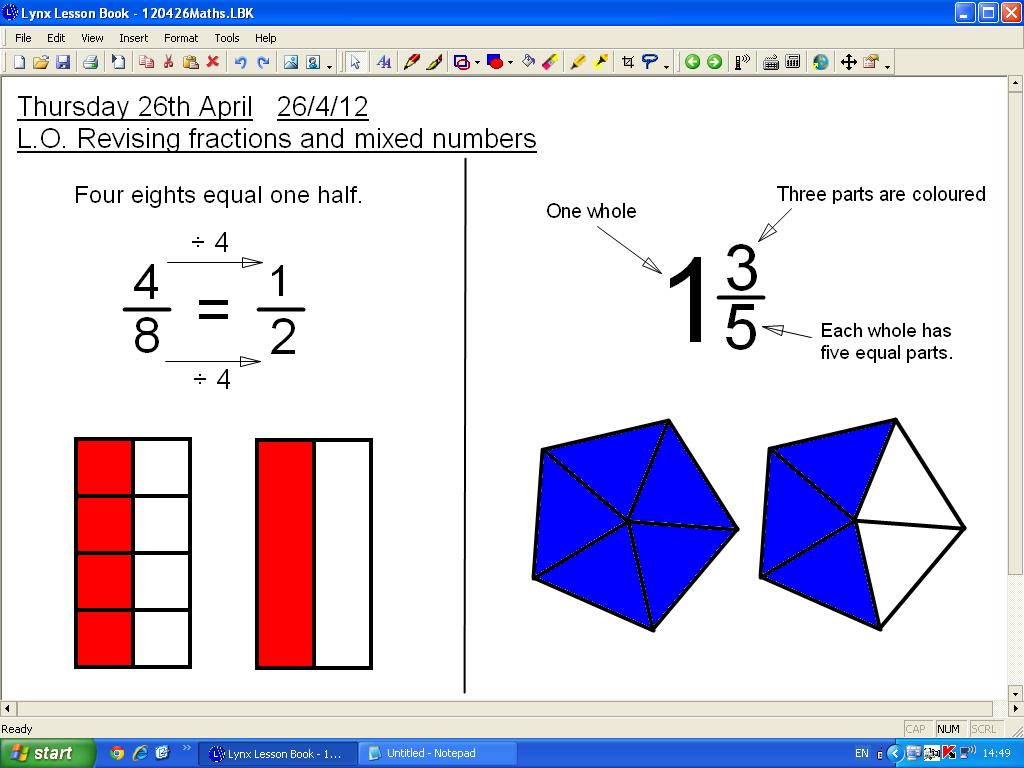
We checked our homework, which was all about fractions and mixed numbers.  Check out the board above.  Can you see where all the numbers come from?  In a fraction, the bottom number tells you how many equal parts make a whole.  The top number tells you how many parts are coloured.  In a mixed number, the big number tells you how many whole ones are coloured.